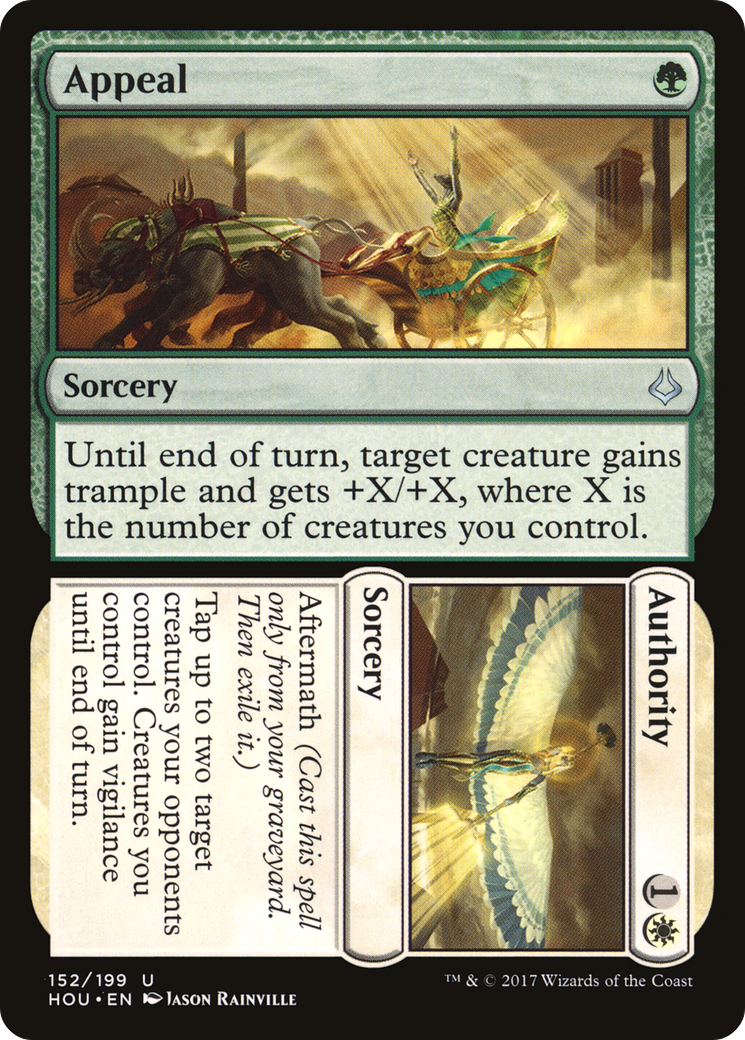
Until end of turn, target creature gains trample and gets +X/+X, where X is the number of creatures you control.
//
Aftermath (Cast this spell only from your graveyard. Then exile it.)
Tap up to two target creatures your opponents control. Creatures you control gain vigilance until end of turn.
Log in to favorite this card, track copies, or add it to a deck or wishlist.
Printing details
About this card
Set
Amonkhet Remastered (AKR)
Collector number
227
Rarity
Uncommon
Released
August 13, 2020
Artist
Jason Rainville
Language
English
Mana value
3
Oracle ID
3ecc4b57-3e0c-48b8-9952-e4b63b6bc45d
Color profile
Color identity
White
Green
Format check
Legality
TLR
Legal
Duel
Legal
Brawl
Legal
Penny
Not legal
PreDH
Not legal
Future
Not legal
Legacy
Legal
Modern
Legal
Pauper
Not legal
Alchemy
Not legal
Pioneer
Legal
Vintage
Legal
Historic
Legal
Standard
Not legal
Timeless
Legal
Commander
Legal
Gladiator
Legal
Old School
Not legal
Premodern
Not legal
Oathbreaker
Legal
Standard Brawl
Not legal
Pauper Commander
Not legal
Competitive Brawl
Legal
Official notes
Rulings
12
Wizards of the Coast
The value of X is determined only as Appeal begins to resolve. It won’t change later in the turn if the number of creatures you control changes.
Wizards of the Coast
You may cast Authority without choosing any target creatures. Creatures you control will still gain vigilance until end of turn. However, if you choose any targets and each of those targets become illegal before Authority resolves, the spell won’t resolve and your creatures won’t gain vigilance.
Wizards of the Coast
Once you’ve started to cast a spell with aftermath from your graveyard, the card is immediately moved to the stack. Opponents can’t try to stop the ability by exiling the card with an effect such as that of Crook of Condemnation.
Wizards of the Coast
Each split card has two names. If an effect instructs you to choose a card name, you may choose one, but not both.
Wizards of the Coast
While not on the stack, the characteristics of a split card are the combination of its two halves. For example, Destined // Lead is a green and black card, it is both an instant card and a sorcery card, and its mana value is 6. This means that if an effect allows you to cast a card with mana value 2 from your hand, you can’t cast Destined. This is a change from the previous rules for split cards.
Wizards of the Coast
If you cast the first half of a split card with aftermath during your turn, you’ll have priority immediately after it resolves. You can cast the half with aftermath from your graveyard before any player can take any other action if it’s legal for you to do so.
Wizards of the Coast
Split cards with aftermath have a new frame treatment—the half you can cast from your hand is oriented the same as other cards you’d cast from your hand, while the half you can cast from your graveyard is a traditional split card half. This frame treatment is for your convenience and has no rules significance.
Wizards of the Coast
If another effect allows you to cast a split card with aftermath from a graveyard, you may cast either half. If you cast the half that has aftermath, you’ll exile the card if it would leave the stack.
Wizards of the Coast
A spell with aftermath cast from a graveyard will always be exiled afterward, whether it resolves, it’s countered, or it leaves the stack in some other way.
Wizards of the Coast
If another effect allows you to cast a split card with aftermath from any zone other than a graveyard, you can’t cast the half with aftermath.
Wizards of the Coast
All split cards have two card faces on a single card, and you put a split card onto the stack with only the half you’re casting. The characteristics of the half of the card you didn’t cast are ignored while the spell is on the stack. For example, if an effect prevents you from casting green spells, you can cast Destined of Destined // Lead, but not Lead.
Wizards of the Coast
Each split card is a single card. For example, if you discard one, you’ve discarded one card, not two. If an effect counts the number of instant and sorcery cards in your graveyard, Destined // Lead counts once, not twice.
Card links
Public deck signals
Often played with
0results
Cards found together in sampled public decks. Lands are excluded and different printings count as one card. This suggests shared play, not a proven combo.
No sampled co-occurrences found
No other nonland cards were found alongside this card in the sampled public decks.